
A Complete Sri Lanka Travel Guide by Just Travel Sri Lanka
If you’ve been waiting for a sign to finally book that Sri Lanka trip — this is it. Roughly the size of Ireland, this island packs more variety per square kilometre than almost anywhere on earth. Ancient ruins, wild beaches, misty tea hills, and leopards in the jungle. It’s the most underrated bucket-list destination in Asia, and we at Just Travel Sri Lanka have spent years learning every corner of it so you don’t have to guess.
Here are the 15 places to visit in Sri Lanka that genuinely earn their place on the list.
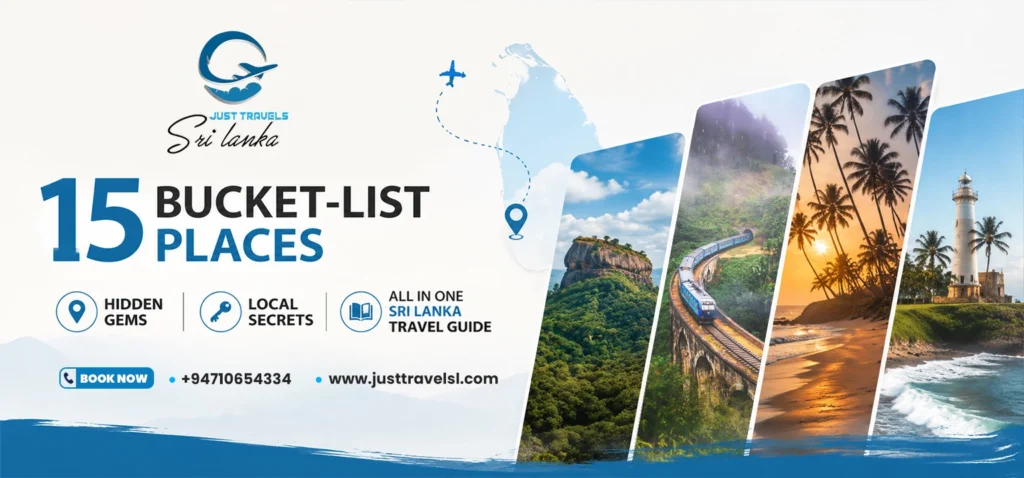
01. Sigiriya — The Lion Rock That Rewires Your Brain
UNESCO World Heritage Site | Central Province
Every Sri Lanka travel guide puts Sigiriya at number one. But it’s not habit — it earns it every time. This is a 5th-century royal palace perched 200 metres above the jungle on a solitary volcanic plug. A fortress. A garden. A royal obsession cast in stone. King Kashyapa built it after seizing the throne from his father, and never quite managed to escape the drama of it all.
The climb involves over 1,200 steps, but every one of them pays off. Halfway up, faded frescoes of cloud maidens have survived fifteen centuries on the open rock face. Near the summit, the famous Mirror Wall still carries inscriptions left by visitors from the 7th century onwards — people who were tourists before tourism was a word.
Just Travel Tip: Arrive when the gates open at 7am. The light is golden, the heat is manageable, and the crowds are thin. By 9am it’s a completely different story. We book early-entry slots for all our guests as standard.
02. Kandy — Where Sri Lanka’s Heart Still Beats
UNESCO World Heritage Site | Cultural Capital
Nestled in a valley ringed by tea-covered hills, Kandy is the cultural soul of Sri Lanka and one of the most beautiful cities in Asia. The last royal capital of the ancient kings, it held out against colonial powers longer than anywhere else on the island — and that independent spirit still lingers in the streets.
The Temple of the Tooth Relic sits at the city’s centre, housing what is believed to be a tooth of the Buddha. The evening puja ceremony — held three times daily — is one of the most moving experiences in Sri Lanka. Drums, incense, candlelight, and hundreds of pilgrims from across the island. It costs nothing and gives everything.
If your timing is right, the Esala Perahera festival in July and August is one of the most spectacular cultural events in all of Asia — ten nights of decorated elephants, fire dancers, and traditional drummers processing through the city streets.
03. Galle Fort — A Colonial Time Capsule on the Southern Coast
UNESCO World Heritage Site | South Coast
Galle Fort is the kind of place that stops you mid-sentence. You turn a corner and suddenly there’s a view that shouldn’t be real. A 16th-century Dutch fort wrapped around a peninsula on Sri Lanka’s south coast, Galle has evolved into a living neighbourhood of boutique hotels, independent bookshops, art galleries, and some of the best restaurants in the country.
Walking the ramparts at sunset — the Indian Ocean glittering on three sides, fishing boats below, the lighthouse blinking in the distance — is one of those experiences you file under “why I travel.” It’s one of the most famous landmarks in Sri Lanka and one of the rare places that combines history, architecture, and atmosphere better than almost anywhere else on the island.
Don’t Miss: The cricket ground inside the fort walls, where international Test matches are played with the ocean as the backdrop. Nowhere else on earth plays cricket like this.
04. Ella — The Hill Station Everyone Falls in Love With
Sri Lanka Hill Country | Tea Trails & Waterfalls
Ella is a small mountain town in Sri Lanka’s highlands that has quietly become one of the most talked-about places in the country. Surrounded by tea plantations, waterfalls, and cool air, it’s the kind of place people arrive in for two nights and end up staying a week.
The Nine Arch Bridge — a colonial-era viaduct still in daily use — is the most photographed thing in the Sri Lanka highlands. Catch a local train crossing it in the morning mist and you have a photograph that will outlive your camera. Little Adam’s Peak is an easy morning hike with views spanning the entire southern hill country. Ella Rock is harder but rewards with some of the best panoramic vistas on the island.
The train journey from Kandy to Ella is consistently called one of the world’s great rail journeys. For any list of top places to visit in Sri Lanka 2026, this is non-negotiable — and we always build it into every itinerary we design.
05. Yala National Park — The Leopard Capital of the World
Wildlife Safari | Southern Sri Lanka
Yala has the highest density of leopards of any national park on earth. A Sri Lanka trip without at least one Yala safari feels genuinely incomplete. Beyond the leopards — and there are usually plenty — Yala delivers sloth bears, elephants bathing at waterfalls, crocodiles, hundreds of bird species, and a landscape that shifts between scrub jungle, open grassland, and lagoons that glow orange in the late afternoon.
The dry season between February and July is best, when animals gather around waterholes. An early morning game drive starting before dawn is a completely different experience from the tourist-heavy late morning jeep queues. We always book the early slots for our guests — it makes all the difference between glimpsing a leopard and watching it for twenty minutes from ten metres away.
06. Mirissa — Whale Watching, Surf Breaks, and Long Beach Nights
South Coast Beach | Marine Wildlife
Mirissa is where the southern coastal road comes alive. A crescent of golden sand bookended by a small headland and a coconut grove, it manages to feel both undiscovered and perfectly formed. The whale watching from Mirissa is among the best in the world — blue whales, sperm whales, spinner dolphins — and the season runs November through April.
This is one of those Sri Lanka tourist places that balances perfectly: good enough to be worth a multi-night stay, not yet so famous that it’s been polished smooth. The fish curry served in the small shacks by the water at sunset is, genuinely, one of the great simple meals on earth.
07. Polonnaruwa — An Entire Ancient Kingdom Left Standing
UNESCO World Heritage Site | North Central Province
While Sigiriya gets the most attention, Polonnaruwa is arguably the more complete historical experience. Sri Lanka’s medieval royal capital stretches across a vast archaeological site containing palaces, temples, irrigation tanks, and the legendary Gal Vihara — four enormous Buddha statues carved directly into a granite outcrop with a precision and beauty that stops people dead a thousand years after they were made.
Rent a bicycle — the site is mostly flat — and spend a morning cycling between the ruins. The early light gives the honey-coloured stonework a warmth that photographs can’t quite capture. One of the must-see places in Sri Lanka that genuinely rewards slow exploration rather than a rushed tick-box visit.
08. Nuwara Eliya — Ceylon Tea at Its Most Beautiful Source
Sri Lanka Highlands | Tea Heritage
They call it “Little England” — and while the rose gardens and colonial-era bungalows have something to do with that, nothing about the landscape feels like England. The tea plantations that carpet every hillside in a deep luminous green are uniquely, unmistakably Sri Lankan. Visit a working factory to understand how your morning cup actually gets made. The smell of fresh tea leaves drying is something that stays with you long after you’ve left the island.
09. Arugam Bay — One of the World’s Best Surf Destinations
East Coast | Adventure Travel
On Sri Lanka’s east coast, facing a different ocean with a different personality, Arugam Bay is a point break that has been drawing surfers since the 1970s. The season runs May to October when the swells are consistent and the sky stays reliably blue. Even non-surfers find something to love here — it carries a relaxed, end-of-the-road energy that’s increasingly hard to find on the more developed south coast.
10–15. The Final Six — Each One Worth the Journey
Udawalawe National Park is Sri Lanka’s best elephant park — not Pinnawala, not Yala, but Udawalawe, where large wild herds roam open grasslands and you can watch them for hours without another vehicle in sight. Elephants here are genuinely wild, and seeing a herd of forty moving across the savannah is something that scales no list.
Dambulla Cave Temple, another UNESCO site, hides 153 Buddha statues inside five ancient cave chambers painted floor-to-ceiling with murals. Stepping inside feels less like entering a temple and more like stepping into a world that has no right to still exist.
Trincomalee on the east coast has one of the deepest natural harbours in the world, pristine beaches that regularly appear on hidden-gem lists, and a warmth of atmosphere that the south coast is slowly losing to its own popularity.
Horton Plains contains World’s End — a sheer escarpment with a 900-metre drop into the southern lowlands. Arrive before 9am before cloud rolls in and the whole thing disappears. The walk across the plateau in the early morning, through dwarf cloud forest and open grassland, is eerie and beautiful in equal measure.
Anuradhapura, Sri Lanka’s first ancient capital, holds the sacred Sri Maha Bodhi — a tree grown from a cutting of the original Bodhi tree under which the Buddha attained enlightenment. Documented continuously for over 2,200 years, it is the oldest living tree with a recorded planting date in the world.Negombo, thirty minutes from the airport, is the perfect gentle entry or exit point — a working Dutch-colonial fishing town with excellent seafood, a relaxed canal system, and enough character to make you glad you didn’t just transit straight through.
Hidden Gems of Sri Lanka Only Locals Know About
The famous landmarks are world-class. But the places that locals actually love — the ones that don’t appear in standard travel guides, the beaches with no signage, the temples you’ll have entirely to yourself — those require someone who actually knows the island.
At Just Travel Sri Lanka, we’ve spent years finding them. Here are six.
Hiriketiya Beach is a horseshoe-shaped bay near Dickwella that most tourists drive straight past on the way to Mirissa. Mellow waves, relaxed beach shacks, half the people, all the charm. This is what Mirissa looked like a decade ago. We suspect it won’t stay a secret much longer, which is exactly why we’re telling you now.
Bundala Wetlands is Sri Lanka’s best-kept birding secret — a Ramsar-designated wetland near Hambantota where flamingos gather seasonally and painted storks wade through shallow lagoons at dusk. Almost no tour operators bring guests here. We do.
Mulgirigala Rock Temple is Sigiriya’s smaller sibling: a jungle-covered granite outcrop stacked with ancient cave temples. You’ll often arrive to find you have it completely to yourself. The views from the summit rival anything on the main tourist circuit, and the climb takes a fraction of the effort.
The Knuckles Mountain Range is a UNESCO-protected cloud forest named for its fist-shaped peaks. Cold streams running off the highlands, endemic birds calling through the canopy, and virtually no other tourists. Our guides know trails that aren’t on any published map, and the trekking camps we use in the valley are genuinely off-grid.
Pasikudah Bay on the east coast has some of the most extraordinary shallow water in Sri Lanka — a wide lagoon where you can walk five hundred metres out and still be knee-deep in turquoise. Brilliant for families, beautiful for everyone, and still quiet enough that a full beach day can feel like a private one.Belihuloya Valley is our most closely held secret — a river valley in the southern hill country where our guides have been running riverside camps for years. Local cooking over a fire, the sound of moving water all night, and morning mist that rolls down off the hills like something from a painting. Completely off-grid, genuinely restorative.
Why Sri Lanka Should Be Your Next Travel Destination
People often ask us: why Sri Lanka over Thailand, or Bali, or the Maldives? It’s a completely fair question. Here’s the honest answer.
Sri Lanka is the only destination in Asia where you can watch wild leopards on a Saturday, stand inside a 2,500-year-old temple on a Sunday, surf a world-class point break on Monday, and eat the freshest tuna you’ve ever had on Tuesday — all within a country you can drive end-to-end in under six hours.
The variety is genuinely unmatched. Eight UNESCO World Heritage Sites. A coastline stretching over 1,340 kilometres. Four distinct climate zones. Ancient civilisations, living religious traditions, and a food culture that deserves far more global attention than it gets.
The value is extraordinary. Sri Lanka offers world-class experiences — private wildlife safaris, boutique colonial heritage hotels, whale watching excursions — at prices that make comparable experiences in East Africa or the Maldives look eye-watering by comparison.
The timing is right. Tourism has recovered strongly but the infrastructure hasn’t yet been smoothed into homogeneity. The guesthouses are still run by families, not chains. The roads to the hidden places still feel like discoveries. The local guides still genuinely care whether you have a good time. Go before all of this becomes nostalgia.
The food alone is worth a long-haul flight. Sri Lankan cuisine — coconut-rich curries, hoppers and kottu, fresh seafood cooked with spice and tamarind, endless short eats and street food — is one of Asia’s great culinary traditions and one of its most underrated.
There is a reason that Sri Lanka consistently appears on “best travel destinations” lists year after year. The island is, simply, remarkable. And 2026 remains a beautiful time to experience it.
How Just Travel Sri Lanka Will Guide Your Entire Trip
We are not a booking platform. We are not an algorithm that assembles itineraries from a database. We are a team of people who live in Sri Lanka, travel every route we recommend, and know which family runs the best guesthouse in Ella, which jeep driver at Yala has an instinct for leopards that borders on supernatural, and which three beaches on the east coast nobody else is sending their guests to yet.
Here’s what working with us actually looks like.We start with you, not a template. Before we build a single itinerary, we have a proper conversation about what kind of traveller you are, what you’ve done before, what you want to feel on this trip, and what you absolutely want to avoid. The Sri Lanka bucket list destinations we suggest for a family with children aged eight and twelve look nothing like what we’d build for two thirty-somethings who want to surf and eat well and sleep in beautifully designed places.
We handle everything. Hotels, private transport, guides, entrance tickets, restaurant reservations where needed, ferry bookings, internal flights if relevant, visa and arrival briefings. You land in Colombo and everything works. That’s the deal.
Our guides are locals, not scripts. Every guide we work with is Sri Lankan, deeply knowledgeable, and selected because they genuinely love sharing this island with curious visitors. They’ll take you somewhere spontaneous when something presents itself. They’ll slow down when you want to linger. They won’t rush you through the UNESCO sites Sri Lanka is famous for just to tick boxes on a schedule.
We are reachable throughout your trip. Not via a chatbot. Via a phone number where a real person answers, who knows your itinerary and can solve problems. Because sometimes things change — weather, a road closure, a better opportunity — and having someone who can adapt your day in real time is the difference between a good trip and a great one.
We’re honest about what’s worth it. We’ll tell you when something doesn’t live up to the hype, when a famous landmark is best skipped in favour of something lesser-known, and when two nights somewhere is genuinely better than one. We have no interest in selling you things that won’t serve your trip.
Sri Lanka is an extraordinary island. Let us show it to you properly.
Ready to start planning? Contact the Just Travel Sri Lanka team today for a free, no-obligation consultation. We’ll start with a conversation and end with an itinerary that feels like it was made for you — because it was.
justtravelsl.com | hello@justtravelsl.com
Just Travel Sri Lanka — Your Island. Our Expertise.
FAQ: Sri Lanka Travel — Everything You Need to Know
1. What is the best time to visit Sri Lanka?
There’s no single answer — it depends where you’re going. December to March is ideal for the south and west coast. May to September suits the east coast perfectly. The hill country is enjoyable year-round. The good news? With the right planning, any month works beautifully. That’s exactly what we help you figure out at Just Travel Sri Lanka.
2. How many days do I need in Sri Lanka?
Ten days covers the highlights comfortably. Two weeks is the sweet spot — Cultural Triangle, hill country, and the south coast with time to breathe. Three weeks lets you go deeper, slower, and further off the beaten track. Even seven days, planned well, leaves people booking a return trip before they’ve landed home.
3. Is Sri Lanka safe for tourists in 2026?
Yes, genuinely. Sri Lanka is a warm, welcoming country with a long tradition of hospitality. Millions of international visitors travel here every year without issue. Standard common sense applies — as it does anywhere — but most travellers come home saying the people were the best part of the entire trip.
4. How many UNESCO World Heritage Sites does Sri Lanka have?
Eight — which is extraordinary for an island this size. Sigiriya, Polonnaruwa, Anuradhapura, Kandy, Dambulla, Galle Fort, Sinharaja Forest Reserve, and the Central Highlands. A well-planned two-week trip can cover most of them. We build every single one into our itineraries with enough time to actually experience them, not just photograph them.
5. Do I need a visa to visit Sri Lanka?
Most nationalities need an Electronic Travel Authorization (ETA), applied for online before travel. It takes about fifteen minutes, approval usually comes within twenty-four hours, and it covers a thirty-day stay. Every Just Travel Sri Lanka guest receives a full pre-departure briefing covering visas, vaccinations, currency, and packing — so you arrive feeling ready, not stressed.